Reasons Parents Decide to Never See You Again
Family estrangement: Why adults are cut off their parents
(Paradigm credit:
Getty Images
)
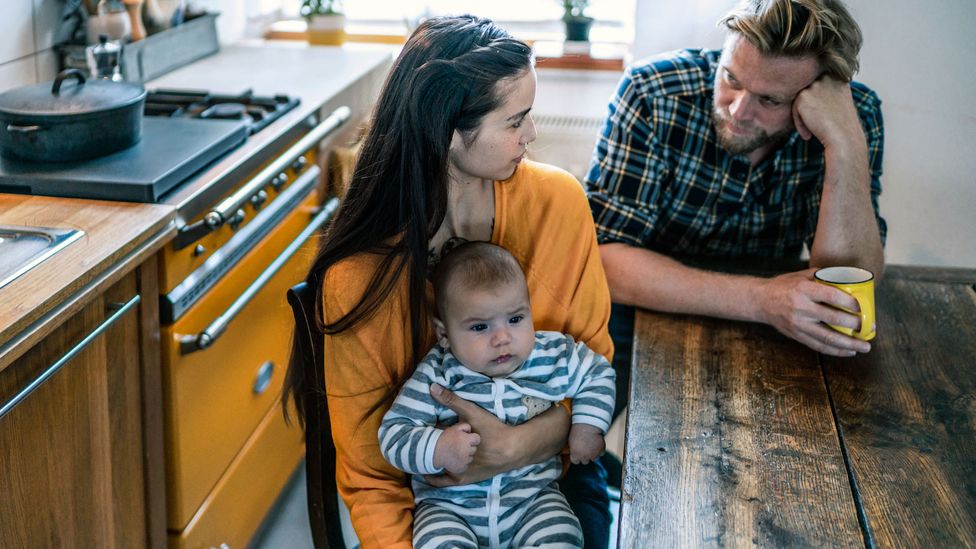
Polarised politics and a growing awareness of how difficult relationships tin can impact our mental health are fuelling family estrangement, say psychologists.
A
Every bit we head into 2022, Worklife is running our best, nearly insightful and about essential stories from 2021. When you're done with this article, check out our full list of the twelvemonth's peak stories.
It was a heated Skype conversation nigh race relations that led Scott to cutting off all contact with his parents in 2019. His mother was angry he'd supported a civil rights activist on social media, he says; she said "a lot of actually atrocious racist things", while his seven-yr-old son was in earshot.
"There was very much a parental feeling similar 'you can't say that in front of my kid, that'south not the way nosotros're going to raise our kids'," explains the father-of-two, who lives in Northern Europe. Scott says the final straw came when his father tried to defend his mother'south viewpoint in an e-mail, which included a link to a white supremacist video. He was baffled his parents could not embrace the reality of people being victimised considering of their background, especially given his own family unit history. "'This is insane – you're Jewish', I said. 'Many people in our family were killed in Auschwitz'."
It wasn't the first time Scott had experienced a clash in values with his parents. But information technology was the concluding time he chose to see or speak to them.
Despite a lack of hard data, there is a growing perception among therapists, psychologists and sociologists that this kind of intentional parent-child 'break-upwards' is on the ascent in western countries.
Formally known as 'estrangement', experts' definitions of the concept differ slightly, only the term is broadly used for situations in which someone cuts off all advice with one or more than relatives, a situation that continues for the long-term, even if those they've sought to carve up from endeavour to re-establish a connection.
"The proclamation of 'I am done' with a family unit member is a powerful and distinct phenomenon," explains Karl Andrew Pillemer, professor of human development at Cornell University, U.s.. "It is different from family feuds, from loftier-conflict situations and from relationships that are emotionally distant simply however include contact."
Afterward realising there were few major studies of family estrangement, he carried out a nationwide survey for his 2020 book Fault Lines: Fractured Families and How to Mend Them. The survey showed more than one in iv Americans reported existence estranged from some other relative. Like research for British estrangement clemency Stand up Alone suggests the phenomenon affects one in 5 families in the U.k., while bookish researchers and therapists in Australia and Canada as well say they're witnessing a "silent epidemic" of family unit suspension-ups.
On social media, in that location'southward been a boom in online support groups for adult children who've chosen to be estranged, including one Scott is involved in, which has thousands of members. "Our numbers in the grouping have been rising steadily," he says. "I recollect it's becoming more and more mutual."
The fact that estrangement betwixt parents and their developed children seems to be on the ascent – or at least is increasingly discussed – seems to exist down to a circuitous spider web of cultural and psychological factors. And the trend raises enough of questions about its touch on both individuals and society.
By experiences and present values
Although research is limited, about intermission-ups between a parent and a grown-up kid tend to exist initiated by the child, says Joshua Coleman, psychologist and author of The Rules of Estrangement: Why Adult Children Cut Ties and How to Heal the Conflict. 1 of the most common reasons for this is past or nowadays abuse past the parent, whether emotional, verbal, physical or sexual. Divorce is another frequent influence, with consequences ranging from the adult child "taking sides", to new people coming into the family such as stepsiblings or stepparents, which can fuel divisions over both "fiscal and emotional resources".
Clashes in values – as experienced by Scott and his parents – are also increasingly thought to play a role. A study published in October by Coleman and the University of Wisconsin, US, showed value-based disagreements were mentioned past more than than ane in iii mothers of estranged children. Pillemer'south recent research has also highlighted value differences as a "major factor" in estrangements, with conflicts resulting from "problems such as same sex-preference, religious differences or adopting culling lifestyles".
Both experts believe at to the lowest degree part of the context for this is increased political and cultural polarisation in contempo years. In the Usa, an Ipsos poll reported a rise in family rifts subsequently the 2016 election, while research by academics at Stanford University in 2012 suggested a larger proportion of parents could be unhappy if their children married someone who supported a rival political political party, which was far less true a decade earlier. A recent Britain study institute that one in 10 people had fallen out with a relative over Brexit. "These studies highlight the way that identity has become a far greater determinant of whom nosotros cull to go on shut or to let go," says Coleman.
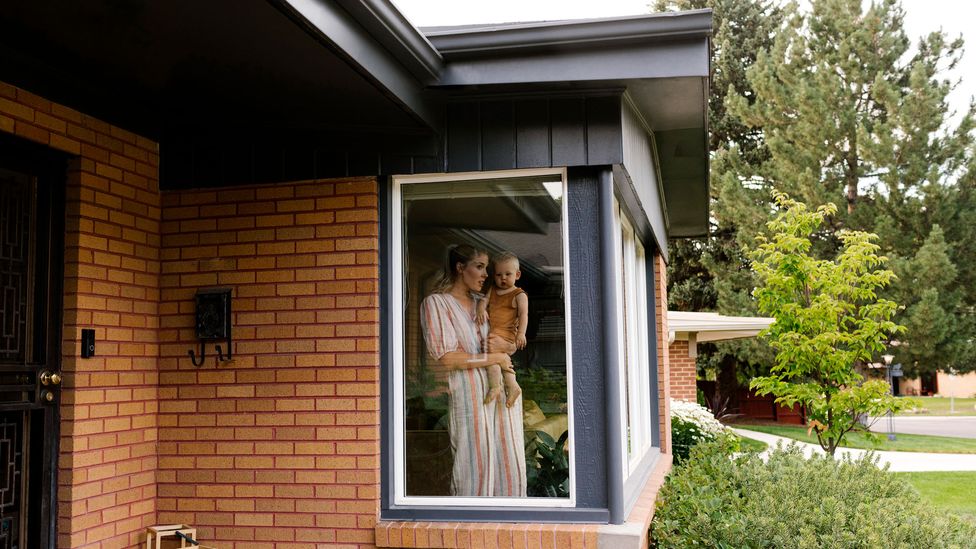
Children tin can likewise be affected by severed ties, every bit they lose out on relationships with their grandparents (Credit: Getty Images)
Family Tree
This story is part of BBC's Family Tree series, which examines the issues and opportunities parents, children and families face today – and how they'll shape the globe tomorrow. Coverage continues on BBC Future.
Scott says he's never discussed his voting preferences with his parents. But his decision to cut them off was partly influenced by his and his wife's heightened awareness of social problems, including the Black Lives Matter movement and MeToo. He says other adult children in his online back up grouping accept fallen out due to value-based disagreements connected to the pandemic, from older parents refusing to get vaccinated to rows over conspiracy theories about the source of the virus.
The mental wellness factor
Experts believe our growing awareness of mental health, and how toxic or abusive family relationships can affect our wellbeing, is also impacting on estrangement.
"While at that place's nothing peculiarly modern about family conflict or a want to feel insulated from it, conceptualising the estrangement of a family member as an expression of personal growth, equally it is commonly done today, is virtually certainly new," says Coleman. "Deciding which people to proceed in or out of one's life has get an important strategy."
Sam, who's in her twenties and lives in the U.k., says she grew upward in a volatile household where both parents were heavy drinkers. She largely stopped speaking to her parents directly after leaving domicile for academy, and says she cut ties for good afterwards witnessing her male parent verbally abusing her six-year-old cousin at a funeral. Having therapy helped her recognise her own experiences as "more than than just bad parenting" and procedure their psychological affect. "I came to understand that 'abuse' and 'neglect' were words that described my childhood. Only because I wasn't hitting didn't mean I wasn't harmed."
She agrees with Coleman it's "becoming more socially acceptable" to cut ties with family members. "Mental wellness is more talked near now so it'southward easier to say, 'These people are bad for my mental health'. I remember, every bit well, people are getting more than confident at cartoon their own boundaries and maxim 'no' to people."
The ascent of individualism
Coleman argues our increased focus on personal wellbeing has happened in parallel with other wider trends, such as a shift towards a more "individualistic civilization". Many of the states are much less reliant on relatives than previous generations.
"Not needing a family unit fellow member for support or because you plan to inherit the family farm means that who we choose to spend fourth dimension with is based more on our identities and aspirations for growth than survival or necessity," he explains. "Today, cipher ties an adult child to a parent beyond that adult child's want to have that human relationship."
Increased opportunities to live and piece of work in dissimilar cities or even countries from our developed families can also assistance facilitate a parental suspension-up, simply by adding physical distance.
"It's been much easier for me to movement around than information technology would have been probably 20 years agone," agrees Faizah, who is British with a South Asian groundwork, and has avoided living in the same surface area equally her family unit since 2014.
She says she cut ties with her parents because of "controlling" behaviours similar preventing her from going to job interviews, wanting an influence on her friendships and putting force per unit area on her to get married straight after her studies. "They didn't respect my boundaries," she says. "I but want to have ownership over my own life and make my own choices."
The bear on of estrangement
At that place are strong positives for many estranged adult children who've discrete themselves from what they believe are damaging parental relationships. "The research shows that the majority of adult children say it was for the best," says Coleman.
But while improved mental health and perceived increased liberty are common outcomes of estrangement, Pillemer argues the determination can also create feelings of instability, humiliation and stress.
"The intentional, agile severing of personal ties differs from other kinds of loss," he explains. "In add-on, people lose the practical benefits of being part of a family: textile support, for case, and the sense of belonging to a stable group of people who know one another well."
Feelings of loneliness and stigma seem to have been exacerbated for many estranged people during the pandemic. While the 'Zoom boom' enabled some families to feel closer and stay in touch more regularly, recent Britain research suggests that adults with severed ties felt even more aware of missing out on family life during lockdown. Other studies bespeak to Christmas and religious festivals being peculiarly challenging periods for estranged relatives.
"I have my own family and my partner and my close friends, only nada replaces those traditions you have with your parents," agrees Faizah. At present in her thirties, she still finds the Muslim vacation Eid al-Fitr particularly tricky, even though she'southward distanced herself from her parents' organized religion. "Information technology's and then tough. Information technology'south so lonely... and I practise miss my mum's cooking."
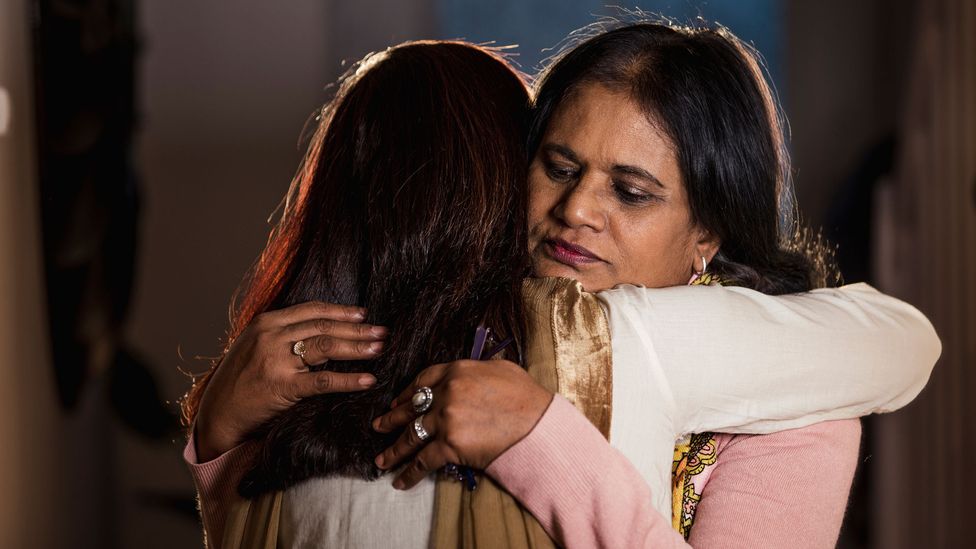
Estrangement, though difficult to navigate, may non be permanent as people can successfully reconcile (Credit: Getty Images)
Choosing not to stay in impact with parents tin can have a knock-on effect on hereafter family unit bonds and traditions, likewise. "For me, the biggest regret is my kids growing up without grandparents," says Scott . "It's preferable to [my parents] saying – gosh, I don't know what – to them [but] I feel like my kids are missing out."
Of class, all of this also has an impact on the parents who accept, oftentimes unwillingly, been cutting out of their children'southward – and potentially grandchildren's – lives. "Most parents are made miserable past it," says Coleman. Too equally losing their own footing in the traditional family, they typically "describe profound feelings of loss, shame and regret".
Scott says his mother recently tried calling him. Only he texted her saying he'd only consider re-establishing contact with his children if she recognised her comments had been "horribly racist" and apologised. So far, he says she hasn't done that. "Even if all those things happened, I would always limit what I tell them nigh my life and certainly supervise any visits with the kids. Unfortunately, I don't come across whatever of that happening."
Attempting to span rifts?
With political divisions eye-stage in many nations, as well as increasing individualism in cultures around the world, many experts believe the parent-child 'break-upwardly' tendency will stick around.
"My prediction is that information technology's either going to get worse or stay the aforementioned," says Coleman. "Family relationships are going to be based much more on pursuing happiness and personal growth, and less on emphasising duty, obligation or responsibility."
Pillemer argues that we shouldn't rule out attempting to bridge rifts, even so, especially those stemming from opposing politics or values (as opposed to calumniating or damaging behaviours).
"If the prior relationship was relatively close (or at least not conflictual), I think there is prove that many family members tin restore the relationship. Information technology does involve, nonetheless, agreeing on a 'demilitarised zone' in which politics cannot be discussed," he says.
For his book, he interviewed over 100 estranged people who had successfully reconciled, and constitute the process was really framed past many every bit "an engine for personal growth". "It is of class not for anybody, but for a number of people, bridging a rift, even if the relationship was imperfect, was a source of self-esteem and personal pride."
He argues that both more detailed longitudinal studies and clinical attention are needed to become the topic of estrangement further "out of the shadows and into the clear calorie-free of open word". "We need researchers to notice better solutions – both for people who want to reconcile, and for help in coping with people in permanent estrangements."
Scott welcomes the growing interest in adult break-ups. "I think it volition help lots of people," he says. "There is yet a large stigma around estrangement. We see these questions in the grouping a lot: 'What do yous tell people?' or 'How do you lot bring it upward when dating?".
But he's unlikely to reconcile with his own parents, unless they recognise they've been racist. "The whole 'blood is thicker than water' - I mean, that's great if you have a cool family, simply if you're saddled with toxic people, it's only not doable."
Scott, Sam and Faizah are all using one proper noun to protect their and their families' privacy
charlesmarproduch.blogspot.com
Source: https://www.bbc.com/worklife/article/20211201-family-estrangement-why-adults-are-cutting-off-their-parents
0 Response to "Reasons Parents Decide to Never See You Again"
Postar um comentário