In Office ane of our Energy & Metabolism overview, we talked about the different types of nutrients your body needs and how information technology breaks them downwards into chemical components your torso can use. At present information technology'south time to talk about how the body uses glucose to create one of the most important molecules in biology: ATP.
If yous were following the arcade metaphor from the previous mail service, at present it'due south time for the good role. You've cleaved down that $20 (a polysaccharide) into a bunch of $i bills (glucose) and you're ready to get yourself some shiny gilded tokens and so yous can play games!
Adenosine Triphosphate: Biological Arcade Token
Equally much as it might seem so, glucose isn't free energy per se. The energy in glucose is transferred to a molecule called ATP (adenosine triphosphate). ATP is the real deal when it comes to powering your cells' functions—it's the arcade token you lot demand to play skee-ball or Tetris or Pacman. When ATP is cleaved downwards into ADP, stored-upwardly free energy is released.
In your body, ATP is involved in muscle contraction, the transmission of nervus impulses, transporting ions and molecules beyond cell membranes, and a host of anabolic reactions such as the assembly of proteins and lipids. You fifty-fifty demand ATP to brand more ATP.
So how do you brand ATP? Cellular respiration. It goes a little something like this:
C6H12O6 + 6Otwo → 6CO2 + 6HtwoO + Energy (approximately 38 ATP)
Basically, what this chemic formula says is that in gild to produce ATP, you lot need a molecule of glucose and some oxygen. When you lot utilize those to brand ATP, carbon dioxide and water will also exist produced. Sound familiar? That's probably because our bodies take in oxygen, our cells utilise information technology for respiration, and we exhale out carbon dioxide!
The transition from glucose to ATP doesn't take place all at in one case, though. Cellular respiration is made up of four sub-processes: glycolysis, the citric acrid cycle (Krebs Cycle), and oxidative phosphorylation. Allow'south talk about each one in particular.
Glycolysis: The Foundation of Cellular Respiration
Glycolysis, the first step of cellular respiration, occurs in the cytoplasm of your cells. During this process, a glucose molecule is cleaved down into two molecules of pyruvate (pyruvic acid). This procedure requires the investment of 2 ATP molecules and yields 4 ATP in improver to the pyruvate and some other type of molecule called NADH, which will contribute to the terminal step of cellular respiration.
| Process | Location | Input | Output |
| Glycolysis | Cytoplasm | one Glucose (C6H12O6) 2 ATP | 2 Pyruvate (C3H4O3) *iv ATP 2 NADH |
*Remember: even though glycolysis produces 4 ATP, you take to pay two ATP to get it started, and then at that place'south really only a cyberspace proceeds of 2 ATP.
Hither's the very beginning of the process, with the 2 ATP and 1 C6H12O6to become glycolysis started in the prison cell's cytoplasm.
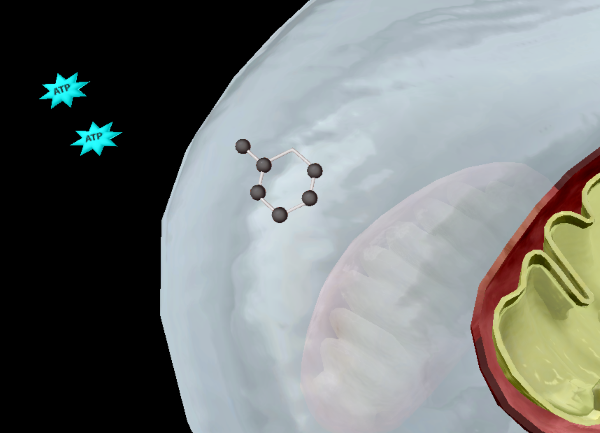
The kickoff of glycolysis, the first step in aerobic cellular respiration. Paradigm from Visible Biological science.
In the image beneath, you can meet the outputs of glycolysis. 4 ATP are generated (two of which will fuel another round of glycolysis), and 2 molecules of pyruvate (CthreeH4O3) and 2 NADH are fix to move to the next stage of aerobic cellular respiration.
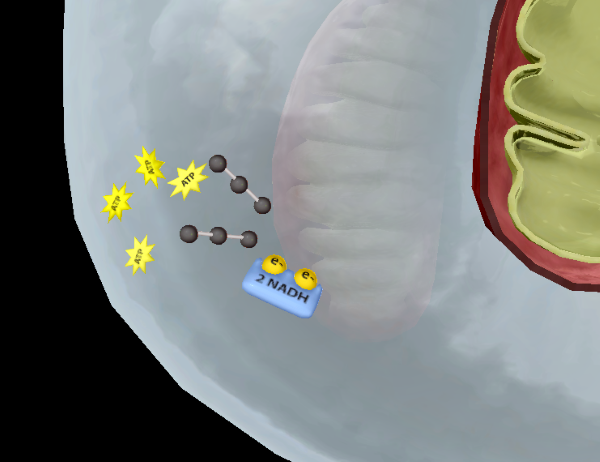
The stop results of glycolysis, the first step in aerobic cellular respiration. Prototype from Visible Biology.
It's worth mentioning that glycolysis is the outset step in both aerobic and anaerobic cellular respiration. Cellular respiration tin can proceed in the absenteeism of oxygen, just information technology looks pretty different after glycolysis. If oxygen isn't present, some organisms, like many gut leaner, can undergo anaerobic (without oxygen) fermentation. This is the source of much intestinal gas.
Ultimately, the goal of fermentation is to go along glycolysis going (and producing its tiny amount of ATP) by converting NADH dorsum into NAD+. You're probably familiar with the byproducts of fermentation in several dissimilar organisms—for example, yeast produces the booze that gives beer its authorization. Bacteria similar Lactobacillus, which are used in yogurt and buttermilk, produce lactic acid, giving those dairy products their tangy gustation.
Some muscle fibers use anaerobic glycolysis to generate energy, and the end product of that process is lactate. The lactate is carried away past the claret stream and is recycled past the liver. Recent research also suggests that lactate production also occurs in aerobic conditions.
Pyruvate Oxidation: Getting Ready for the Citric Acid Bicycle
And at present, back to aerobic cellular respiration. Later on glycolysis and before the citric acrid bike, the two pyruvate molecules lose their carboxyl groups (the carbon molecules that are removed are released every bit CO2) and combine with coenzyme A to form acetyl-CoA.
| Procedure | Location | Input | Output |
| Pyruvate -> acetyl-CoA | Mitochondria (Matrix) | 2 Pyruvate | 2 NADH two COtwo ii Acetyl-CoA |
Acetyl-CoA is the starting ingredient for the Citric Acid Cycle, which is carried out inside a cell'south mitochondria (the famed "powerhouse of the jail cell").
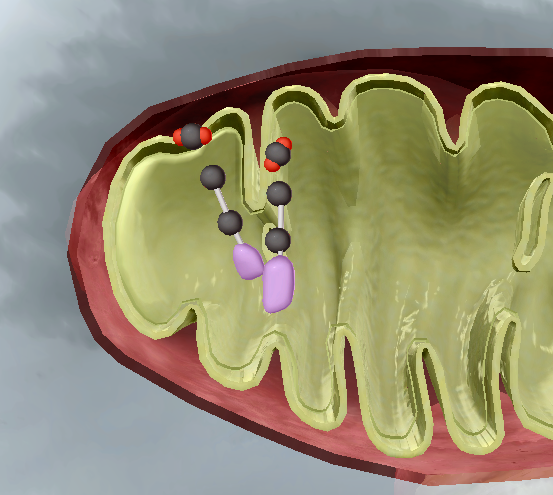
Carbon dioxide being released, and 2 acetyl-CoA molecules gear up to begin the citric acid cycle inside a mitochondrion. Prototype from Visible Biological science.
The Citric Acid Cycle: Once More than, With Feeling
The Citric Acrid Cycle gets its name from the fact that in its start step, the acetyl group from ane of the acetyl-CoA molecules combines with oxaloacetic acrid (C4H4Ov) to form citric acid (C6H8O7).
This citric acid molecule so goes through a serial of chemical reactions. The energy from these reactions is captured in carrier molecules: NAD+ becomes NADH and FAD becomes FADHii. 2 molecules of CO2 are produced as a waste product, and one molecule of ATP is also produced along the way.
At the end of all these reactions, the citric acid has been cleaved down and nosotros're left with oxaloacetic acid once again. This is peachy, because the other acetyl-CoA needs to go through the cycle likewise. Because of this, we say that there are two "turns" in the Citric Acid Cycle—one for each acetyl-CoA.
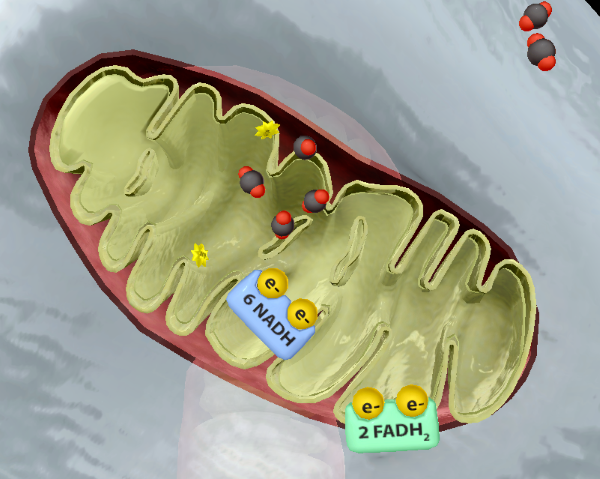
The end result of two rounds of the Citric Acid Wheel. Image from Visible Biological science.
| Process | Location | Input | *Output |
| Citric Acid Cycle (Krebs Cycle) | Mitochondria (Matrix) | 2 Acetyl-CoA | two ATP 6 NADH two FADHtwo 4 CO2 |
*The numbers in this chart represent the full of both "turns" of the Citric Acrid Cycle.
Oxidative Phosphorylation: Mass-Producing ATP
Oxidative phosphorylation is where most of the ATP really comes from. It consists of two steps—the electron ship chain and chemiosmosis—which create and use an electrochemical gradient to produce ATP from ADP.
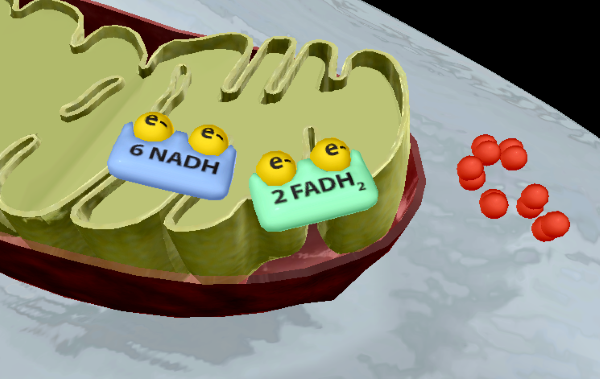
The electron transport concatenation nigh to start churning out ATP. Epitome from Visible Biology.
High-energy electrons from FADH2 and NADH are used to pump hydrogen ions (H+) beyond the inner membrane of the mitochondrion, into the outer compartment. This creates an imbalance: there's a whole bunch of positively charged ions on one side of the membrane and they want to cross back over information technology to restore equilibrium.
The hydrogen ions travel back across the membrane through a protein called ATP synthase. The passage of the ions through it "powers" the ATP synthase, allowing it to turn an ADP (adenosine diphosphate) molecule into an ATP (adenosine triphosphate) molecule by calculation a third phosphate grouping to it. Proceed in heed that when a molecule of ATP is "spent" later, this tertiary phosphate grouping is removed, releasing free energy and changing the ATP dorsum into ADP.
| Process | Location | Input | Output |
| Oxidative Phosphorylation | Mitochondria (Inner Membrane) | Electrons (Carried by half-dozen NADH and ii FADH2 from the Citric Acid Cycle) Oxygen (serves as terminal acceptor for "spent" electrons) | 6H2O 34(ish) ATP |
Learn about diffusion and the electron transport concatenation with this lesson from our Visible Biology YouTube series with Dr. Cindy Harley.
Information technology's during this final stage of cellular respiration that we see the of import function oxygen plays. Oxygen serves as the final acceptor for "spent" electrons, combining them with H+ to form our BFF HiiO.
The verbal number of ATP molecules that are generated by the ETC varies from cell to prison cell. A skilful estimate is nearly ii-3 ATP per NADH and 1.5 ATP per FADH2. A very efficient cell tin produce a total of 38 ATP from a single glucose molecule. If we consider that glycolysis and the Krebs Cycle generate a total of 4 of those ATPs, that means that the ETC tin can produce 34 ATP molecules in i go.
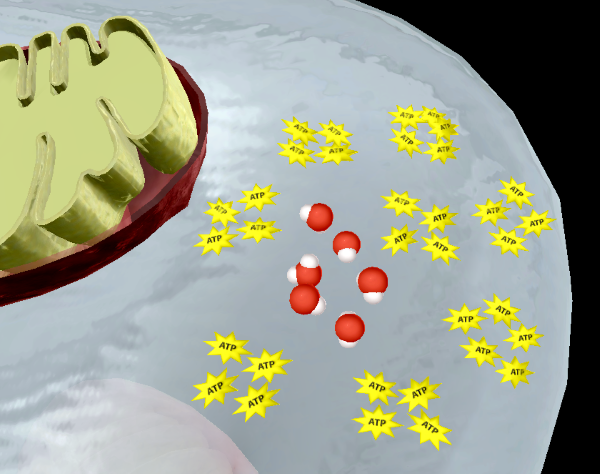
The cease result of the ETC and oxidative phosphorylation: h2o molecules and a whole bunch of ATP! Prototype from Visible Biological science.
Aerobic cellular respiration certainly has its benefits—if glycolysis was our but way of producing ATP, nosotros definitely wouldn't have enough to comport out all our body's bones functions!
And there yous have information technology, the very abridged version of cellular respiration! Hither's a nautical chart summarizing each stage of aerobic cellular respiration:
| Process | Location | Input | Output |
| Glycolysis | Cytoplasm | 1 Glucose (CviH12O6) 2 ATP | two Pyruvate (C3H4O3) 4 ATP 2 NADH |
| Pyruvate Oxidation | Mitochondria (Matrix) | two Pyruvate | two NADH two COii two Acetyl-CoA |
| Citric Acid Cycle (Krebs Wheel) | Mitochondria (Matrix) | ii Acetyl-CoA | two ATP 6 NADH 2 FADH2 four CO2 |
| Oxidative Phosphorylation | Mitochondria (Inner Membrane) | | 6H2O 34(ish) ATP |
Want a quick review of cellular respiration? Check out this two-infinitesimal overview of cellular respiration from our Visible Biology YouTube series:
Exist certain to subscribe to the Visible Body Blog for more anatomy awesomeness!
Are you an instructor? We have award-winning 3D products and resources for your anatomy and physiology course!Learn more here.
Additional Sources:
- Arkansas Dept. of Pedagogy Science Keys: Cellular Respiration
- BBC Bitesize Guides: Respiration
- Chemical science for Centrolineal Health (Chemical science LibreText): xv.2 The Citric Acid Cycle
- Crash Course Biology: ATP & Respiration
- Khan Academy: Electron Transport Concatenation
- Khan Academy: Overview of Cellular Respiration
- NCBI Bookshelf: Oxidative Phosphorylation
0 Response to "what is added to the input molecule at the beginning of the krebs cycle"
Postar um comentário