Where Does the Majority of Beef Come From for Canadian Supermarkets

A supermarket is a self-service shop offering a wide diversity of food, beverages and household products, organized into sections. This kind of store is larger and has a wider option than earlier grocery stores, merely is smaller and more express in the range of merchandise than a hypermarket or large-box marketplace. In everyday U.S. usage, however, "grocery store" is synonymous with supermarket,[1] and is not used to refer to other types of stores that sell groceries.[two] [i]
The supermarket typically has places for fresh meat, fresh produce, dairy, deli items, baked goods, etc. Shelf infinite is also reserved for canned and packaged appurtenances and for various not-food items such as kitchenware, household cleaners, pharmacy products and pet supplies. Some supermarkets also sell other household products that are consumed regularly, such as alcohol (where permitted), medicine, and clothing, and some sell a much wider range of non-food products: DVDs, sporting equipment, board games, and seasonal items (e.yard., Christmas wrapping paper in December).
A larger full-service supermarket combined with a department store is sometimes known as a hypermarket. Other services may include those of banks, cafés, childcare centers/creches, insurance (and other financial services), mobile phone services, photograph processing, video rentals, pharmacies, and gas stations. If the eatery in a supermarket is substantial enough, the facility may be chosen a "grocerant", a alloy of "grocery" and "eatery".[3]
The traditional supermarket occupies a large corporeality of floor space, usually on a single level. It is ordinarily situated about a residential area in order to be user-friendly to consumers. The basic entreatment is the availability of a broad choice of appurtenances under a single roof, at relatively low prices. Other advantages include ease of parking and frequently the convenience of shopping hours that extend into the evening or even 24 hours of the day. Supermarkets commonly allocate large budgets to advertising, typically through newspapers. They also present elaborate in-shop displays of products.
Supermarkets typically are chain stores, supplied by the distribution centers of their parent companies, thus increasing opportunities for economies of scale. Supermarkets normally offering products at relatively low prices by using their ownership power to buy goods from manufacturers at lower prices than smaller stores tin. They also minimise financing costs by paying for goods at to the lowest degree 30 days afterwards receipt and some excerpt credit terms of 90 days or more from vendors. Sure products (typically staple foods such as staff of life, milk and saccharide) are very occasionally sold as loss leaders so equally to attract shoppers to their shop. Supermarkets make up for their depression margins by a high volume of sales, and with of higher-margin items bought past the attracted shoppers. Cocky-service with shopping carts (trolleys) or baskets reduces labor costs, and many supermarket chains are attempting further reduction by shifting to cocky-service check-out.
History [edit]
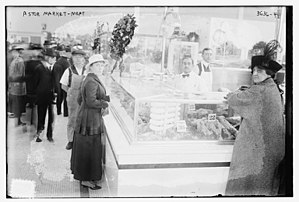
Astor Market in New York, one predecessor of the modernistic supermarket, operated from 1915 to 1917.

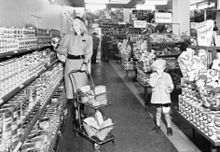
A supermarket in Sweden, 1941

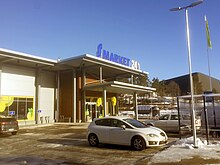
Consumers shopping for produce and fruit, 2012
In the early on days of retailing, generally an assistant fetched products from shelves behind the merchant'south counter while customers waited in front of the counter, indicating the items they wanted. Most foods and merchandise did not come in individually wrapped consumer-sized packages, so an assistant measured out and wrapped the precise corporeality requested by the consumer. This offered opportunities for social interaction: many regarded this fashion of shopping every bit "a social occasion" and would often "pause for conversations with the staff or other customers".[four] These practices were past nature slow and had high labor intensity and therefore also quite expensive. The number of customers who could be attended to at one time was limited by the number of staff employed in the store. Shopping for groceries also frequently involved trips to multiple specialty shops, such as a greengrocer, butcher, bakery, fishmonger and dry appurtenances shop, in addition to a general store. Milk and other items of curt shelf life were delivered past a milkman.
The concept of an inexpensive food market relying on economies of scale was developed by Vincent Astor. He founded the Astor Marketplace in 1915, investing $750,000 of his fortune into a 165′ by 125′ (50×38-metre) corner of 95th and Broadway, Manhattan, creating, in effect, an open-air mini-mall that sold meat, fruit, produce and flowers.[5] The expectation was that customers would come up from great distances ("miles effectually"), but in the end, even attracting people from x blocks away was difficult, and the market folded in 1917.[half-dozen] [7] [8]
The concept of a cocky-service grocery store was adult by entrepreneur Clarence Saunders and his Piggly Wiggly stores, the offset of which opened in 1916. Saunders was awarded several patents for the ideas he incorporated into his stores.[9] [10] [11] [12] The stores were a financial success and Saunders began to offer franchises.
The Neat Atlantic & Pacific Tea Company, which was established in 1859, was another successful early on grocery store chain in Canada and the Us, and became mutual in North American cities in the 1920s. Early cocky-service grocery stores did non sell fresh meats or produce. Combination stores that sold perishable items were developed in the 1920s.
The general trend since then has been to stock shelves at night so that customers, the post-obit day, can obtain their own goods and bring them to the front of the store to pay for them. Although there is a higher risk of shoplifting, the costs of advisable security measures ideally will be outweighed by reduced labor costs.[13] [ unreliable source? ]
Historically, there has been debate about the origin of the supermarket, with King Kullen and Ralphs of California having strong claims.[xiv] Other contenders included Weingarten's and Henke & Pillot.[15] To cease the argue, the Food Marketing Plant in conjunction with the Smithsonian Institution and with funding from H.J. Heinz, researched the issue. They defined the attributes of a supermarket as "self-service, carve up product departments, discount pricing, marketing and volume selling".[ commendation needed ]
They determined that the offset true supermarket in the U.s.a. was opened past a old Kroger employee, Michael J. Cullen, on 4 August 1930, inside a 6,000-foursquare-foot (560 yard2) sometime garage in Jamaica, Queens in New York City.[16] The store, King Kullen, operated under the slogan "Pile information technology high. Sell it depression." At the time of Cullen'due south decease in 1936, there were seventeen King Kullen stores in operation. Although Saunders had brought the world cocky-service, compatible stores, and nationwide marketing, Cullen built on this idea past adding separate food departments, selling large volumes of nutrient at discount prices and calculation a parking lot.

A Safeway advertisement from the 1950s
Other established American grocery chains in the 1930s, such as Kroger and Safeway Inc. at outset resisted Cullen's thought, but eventually were forced to build their own supermarkets as the economy sank into the Smashing Depression, while consumers were becoming cost-sensitive at a level never experienced earlier.[17] Kroger took the idea one footstep further and pioneered the commencement supermarket surrounded on all 4 sides by a parking lot.[ citation needed ]
Every bit larger chain supermarkets began to boss the market in the US, able to supply consumers with the desired lower prices as opposed to the smaller "mom and pop" stands with considerably more than overhead costs, the backlash of this infrastructure amending was seen through numerous anti-chain campaigns. The thought of "monopsony", proposed by Cambridge economist Joan Robinson in 1933, that a single buyer could out-ability the market of multiple sellers, became a strong anti-chain rhetorical device. With public backfire came political pressure to even the playing field for smaller vendors lacking the luxury of economies of scale. In 1936, the Robinson-Patman Deed was implemented as a way of preventing such larger chains from using this buying power to reap advantages over smaller stores, although the act was non well enforced and did not take much impact on the prevention of larger chains overtaking power in the markets.[18]
Supermarkets proliferated across Canada and the Usa with the growth of car ownership and suburban development afterward World War Two. Most North American supermarkets are located in suburban strip shopping centers as an ballast store along. They are generally regional rather than national in their visitor branding. Kroger is perhaps the about nationally oriented supermarket chain in the The states only it has preserved near of its regional brands, including Ralphs, Urban center Marketplace, King Soopers, Fry's, Smith's, and QFC.[ citation needed ] In Canada, the largest such visitor is Loblaw, which operates stores under a variety of banners targeted to dissimilar segments and regions, including Fortinos, Zehrs, No Frills, the Real Canadian Superstore, and Loblaws, the foundation of the visitor. Sobeys is Canada'south 2d largest supermarket with locations beyond the state, operating under many banners (Sobeys IGA in Quebec).[ citation needed ] Québec'southward first supermarket opened in 1934 in Montréal, under the imprint Steinberg's.[19]
In the United Kingdom, cocky-service shopping took longer to become established. Even in 1947, there were just ten self-service shops in the country.[20] In 1951, ex-US Navy sailor Patrick Galvani, son-in-police force of Express Dairies chairman, made a pitch to the board to open a chain of supermarkets across the country. The UK'southward starting time supermarket under the new Premier Supermarkets brand opened in Streatham, Southward London,[21] taking 10 times as much per calendar week equally the average British general store of the time. Other chains caught on, and later Galvani lost out to Tesco's Jack Cohen in 1960 to buy the 212 Irwin's chain, the sector underwent a large amount of consolidation, resulting in 'the big four' dominant United kingdom of great britain and northern ireland of today: Tesco, Asda), Sainsbury'due south and Morrisons.
In the 1950s, supermarkets frequently issued trading stamps every bit incentives to customers. Today, nearly chains issue store-specific "membership cards", "order cards", or "loyalty cards". These typically enable the cardholder to receive special members-just discounts on certain items when the credit card-like device is scanned at check-out.[22] Sales of selected data generated by guild cards is condign a significant revenue stream for some supermarkets.
Traditional supermarkets in many countries face intense competition from discounters such as Wal-Mart, Aldi and Lidl, which typically is non-union and operates with better buying power. Other competition exists from warehouse clubs such as Costco that offer savings to customers ownership in bulk quantities. Superstores, such as those operated by Wal-Mart and Asda, often offering a wide range of goods and services in improver to foods. In Australia, Aldi, Woolworths and Coles are the major players running the industry with violent contest among all the three. The rising market share of Aldi has forced the other two to cut prices and increase their private label product ranges.[23] The proliferation of such warehouse and superstores has contributed to the continuing disappearance of smaller, local grocery stores; increased dependence on the automobile; suburban sprawl because of the necessity for large flooring space and increased vehicular traffic. For instance, in 2009 51% of Wal-Mart's $251 billion domestic sales were recorded from grocery goods.[24] Some critics consider the bondage' mutual practise of selling loss leaders to be anti-competitive. They are also wary of the negotiating ability that large, frequently multinationals accept with suppliers effectually the world.[25]
Online-but supermarkets (21st century) [edit]
During the dot-com boom, Webvan, an online-only supermarket, was formed and went broke afterwards 3 years and was acquired by Amazon. The British online supermarket Ocado, which uses a high degree of automation in its warehouses,[26] was the first successful online-just supermarket. Ocado expanded into providing services to other supermarket firms such every bit Waitrose and Morrisons.
Grocery stores such every bit Walmart employ food delivery services offered by 3rd parties such as DoorDash.[27]
Delivery robots are offered by diverse companies partnering with supermarkets.
Micro-fulfillment centers (MFC) are relatively small-scale warehouses with sophisticated automatic rack-and-tote systems which set up orders for pickup and delivery.[28] Once the order is consummate, the customer volition pick it upwardly (i.e. "click-and-collect") or have it fulfilled via dwelling house delivery.[29] Supermarkets are investing in micro-fulfillment centers with the hope that automation tin can help reduce the costs of online commerce and ecommerce by shortening the distances from store to home and speeding up deliveries. In curt, MFCs are said past many to be the cardinal to profitably fulfilling online orders.[30]
Types [edit]
U.S. categorization [edit]
The U.Due south. FMI food industry association, drawing on research by Willard Bishop, defines the following formats (store types) that sell groceries:[31]
| Store type | Definition as per the U.S. FMI Food Industry Association/Bishop |
|---|---|
| Traditional Grocery | |
| Traditional supermarket | Stores offer a full line of groceries, meat, and produce with at least US$2 one thousand thousand in annual sales and up to 15% of their sales in general merchandise (GM) and health & beauty care (HBC). These stores typically carry anywhere from fifteen,000 to 60,000 SKUs (depending on the size of the store), and may offer a service cafeteria, a service bakery, and/or a pharmacy. e.chiliad., Albertsons, Safeway, and Kroger. |
| Fresh format | Different from traditional supermarkets and traditional natural food stores, fresh stores emphasize perishables and offering centre-store assortments that differ from those of traditional retailers—particularly in the areas of ethnic, natural, and organic, due east.yard., Whole Foods, The Fresh Market, and some independents. |
| Limited-array discount format | A low-priced value-for-money grocery store that offers a express assortment of center-store and perishable items (fewer than 2,000 SKUs), e.g., Aldi, Lidl, Trader Joe's, and Salvage-A-Lot. |
| Super warehouse | A high-book hybrid of a large traditional supermarket and a warehouse store. Super warehouse stores typically offer a full range of service departments, quality perishables, and reduced prices, eastward.g., Cub Foods, Nutrient four Less, and Smart & Concluding. |
| Other (Small Convenience Grocery) | The pocket-size corner grocery store that carries a limited selection of staples and other convenience appurtenances. These to-go stores generate approximately $ane million in business organization annually, e.1000. 7-11, FamilyMart, Alfamart |
| Non-Traditional Grocery | |
| Wholesale club | A membership retail/wholesale hybrid with a varied option and limited variety of products presented in a warehouse-type surroundings. These approximately 120,000 foursquare-foot stores have 60% to 70% GM/HBC and a grocery line defended to large sizes and bulk sales. Memberships include both business accounts and consumer groups, east.g., Sam's Club, Costco, and BJ'southward. |
| Supercenters | A hybrid of a large traditional supermarket and a mass merchandiser. Supercenters offer a wide variety of food, also as non-food trade. These stores average more than 170,000 square feet and typically devote as much as 40% of the space to grocery items, eastward.yard., Walmart Supercenters, Super Target, Meijer, and The Kroger Marketplace stores. |
| Diverseness store | A pocket-size store format that traditionally sold staples and knickknacks, simply now sales of food and consumable items at aggressive price points that account for at to the lowest degree 20%, and up to 66%, of their book, east.k., Dollar General, Dollar Tree, Activeness, Pepco, Poundland and Family unit Dollar. |
| Drug store | A prescription-based drug shop that generates 20% or more than of its total sales from consumables, general merchandise, and seasonal items. This channel includes major concatenation drug stores such every bit Walgreens, DM, AS Watson and CVS. |
| Mass merchandiser | A large store selling primarily hardlines, habiliment, electronics, and sporting goods only also carries grocery and non-edible grocery items. This channel includes traditional Walmart, Kmart, and Target. |
| Military (commissaries) | A format that looks like a conventional grocery store carrying groceries and consumables but is restricted to use by active or retired armed services personnel. Civilians usually are not allowed to store at these stores (referred to equally commissaries). |
| E-Commerce (food and consumables) | Food and consumable products ordered using the cyberspace via any devices, regardless of the method of payment or fulfillment. This channel includes Amazon and Peapod too as the E-Commerce business generated by traditional brick & mortar retailers, due east.g., Coborns (Coborns Delivers) and ShopRite (ShopRite from Dwelling house and ShopRite Delivers). The other non-traditional retail segments to a higher place include their E-Commerce business concern. |
Organic and environmentally-friendly supermarkets [edit]
Some supermarkets are focusing on selling more than (or even exclusively) organically certified produce.[32] [33] Others are trying to differentiate themselves by selling fewer (or no) products containing palm oil.[34] This every bit the need of palm oil is a main driver for the devastation of rainforests. Equally a response to the growing business organization on the heavy utilise of petroleum-based plastics for food packaging, and then-chosen "zero waste" and "plastic-free" supermarkets and groceries are on the rise.[35] [36] [37]
Growth in developing countries [edit]

Outset in the 1990s, the food sector in developing countries has rapidly transformed, especially in Latin America, South-East asia, India, Mainland china and South Africa. With growth, has come up considerable competition and some amount of consolidation.[38] The growth has been driven past increasing abundance and the rise of a middle class; the entry of women into the workforce; with a consistent incentive to seek out easy-to-ready foods; the growth in the use of refrigerators, making it possible to shop weekly instead of daily; and the growth in car ownership, facilitating journeys to distant stores and purchases of large quantities of goods. The opportunities presented by this potential take encouraged several European companies to invest in these markets (mainly in Asia) and American companies to invest in Latin America and China. Local companies too entered the market.[39] Initial development of supermarkets has now been followed by hypermarket growth. In addition at that place were investments by companies such as Makro and Metro Cash and Comport in large-scale Cash-and-Comport operations.
While the growth in sales of processed foods in these countries has been much more than rapid than the growth in fresh food sales, the imperative nature of supermarkets to achieve economies of scale in purchasing ways that the expansion of supermarkets in these countries has important repercussions for pocket-size farmers, specially those growing perishable crops. New supply chains have adult involving cluster formation; development of specialized wholesalers; leading farmers organizing supply, and farmer associations or cooperatives.[40] In some cases supermarkets have organized their own procurement from small farmers; in others wholesale markets accept adapted to meet supermarket needs.[41]
Typical supermarket merchandise [edit]
Larger supermarkets in N America and in Europe typically sell many items amidst many brands, sizes and varieties. U.Southward. publisher Supermarket News lists the following categories, for example:[42] Hypermarkets have a larger range of non-food categories such every bit vesture, electronics, household decoration and appliances.
- Bakery (packaged and sometimes a service bakery and/or onsite baker)
- Beverages (not-alcoholic packaged, sometimes too alcoholic if laws let)
- Nonfood & Chemist's (eastward.g. cigarettes, lottery tickets and over-the-counter medications (every bit laws permit), DVD rentals, books and magazines, including supermarket tabloids, greeting cards, toys, small option of home goods like lite bulbs, housewares (typically limited)
- Personal care eastward.g. cosmetics, soap, shampoo
- Produce (fresh fruits and vegetables)
- Floral (flowers and plants)
- Deli (sliced meats, cheeses, etc.)
- Prepared Foods (packaged and frozen foods)
- Meat (fresh packaged, frozen, sometimes with a butcher service counter)
- Seafood (fresh packaged, frozen, sometimes with a butcher service counter)
- Dairy (milk products and eggs)
- Centre store (due east.grand. detergent, paper products, household cleaning supplies)
- Multicultural (indigenous foods)
- Bulk dried foods
- Animate being foods, toys and products
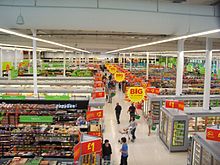

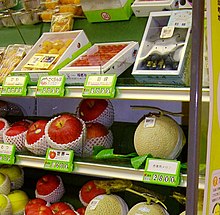
Fruit on display in a supermarket in Nihon
Layout strategies [edit]

Most merchandise is already packaged when it arrives at the supermarket. Packages are placed on shelves, arranged in aisles and sections according to type of item. Some items, such as fresh produce, are stored in bins. Those requiring an intact cold chain are in temperature-controlled display cases.
While branding and store advertising will differ from visitor to visitor, the layout of a supermarket remains virtually unchanged. Although big companies spend time giving consumers a pleasant shopping experience, the pattern of a supermarket is directly connected to the in-store marketing that supermarkets must bear to get shoppers to spend more coin while at that place.
Every aspect of the shop is mapped out and attention is paid to color, wording and even surface texture. The overall layout of a supermarket is a visual merchandising project that plays a major role. Stores can creatively utilise a layout to modify customers' perceptions of the atmosphere. Alternatively, they can enhance the store's atmospherics through visual communications (signs and graphics), lighting, colors, and even scents.[43] For example, to requite a sense of the supermarket being healthy, fresh produce is deliberately located at the front of the shop. In terms of baker items, supermarkets usually dedicate 30 to 40 anxiety of store space to the bread aisle.[44]
Supermarkets are designed to "give each product section a sense of individual deviation and this is evident in the design of what is called the ballast departments; fresh produce, dairy, delicatessen, meat and the bakery". Each section has dissimilar floor coverings, manner, lighting and sometimes even individual services counters to allow shoppers to feel every bit if in that location are a number of markets within this one supermarket.[45]

Marketers use well-researched techniques to try to control purchasing behavior. The layout of a supermarket is considered by some to consist of a few rules of thumb and three layout principles.[46] The high-depict products are placed in separate areas of the store to keep drawing the consumer through the store. High impulse and high margin products are placed in the almost predominant areas to grab attention. Power products are placed on both sides of the aisle to create increased product awareness, and end caps are used to receive a high exposure of a certain production whether on special, promotion or in a campaign, or a new line.
The first principle of the layout is circulation. Circulation is created by arranging product so the supermarket can command the traffic flow of the consumer. Forth with this path, there will be high-draw, high-impulse items that volition influence the consumer to make purchases which they did not originally intend. Service areas such as restrooms are placed in a location which draws the consumer past certain products to create extra buys. Necessity items such as bread and milk are found at the rear of the store to increase the offset of apportionment. Cashiers' desks are placed in a position to promote apportionment. In most supermarkets, the entrance volition be on the right-hand side considering some enquiry suggests that consumers who travel in a counter-clockwise direction spend more.[45] Nonetheless, other researchers have argued that consumers moving in a clockwise direction tin form better mental maps of the store leading to higher sales in plow.[47]
The second principle of the layout is coordination. Coordination is the organized arrangement of product that promotes sales. Products such as fast-selling and tiresome-selling lines are placed in strategic positions in aid of the overall sales programme. Managers sometimes place dissimilar items in fast-selling places to increase turnover or to promote a new line.

The third principle is consumer convenience. The layout of a supermarket is designed to create a loftier degree of convenience to the consumer to brand the shopping experience pleasant and increase customer spending.[48] This is washed through the grapheme of merchandising and product placement. There are many different ideas and theories in relation to layout and how product layout can influence the purchases fabricated. 1 theory suggests that certain products are placed together or near one another that are of a similar or complementary nature to increment the boilerplate client spend.[49] This strategy is used to create cross-category sales similarity. In other words, the toothpaste is next to or adjacent the toothbrushes and the tea and coffee are down the same aisle as the sugariness biscuits. These products complement one another and placing them near is 1-way marketers try to increase purchases.[49]
For vertical placement, inexpensive generic brands tend to be on the lowest shelves, products appealing to children are placed at the mid-thigh level, and the most profitable brands are placed at eye level.[48]
The fourth principle is the utilise of colour psychology, and the locations of the food,[50] similar to its use in fast food branding.
Consumer psychologists suggest that well-nigh buyers tend to enter the shop and shop to their right starting time.[45] Some supermarkets, therefore, cull to place the entrance to the left-hand side as the consumer will likely turn right upon entry, and this allows the consumer to do a total anticlockwise circumvolve around the store before returning to the checkouts. This suggests that supermarket marketers should use this theory to their advantage by placing their temporary displays of products on the right-hand side to entice yous to make an unplanned purchase. Furthermore, aisle ends are extremely popular with product manufacturers, who pay top dollar to have their products located there.[51] These aisle ends are used to lure customers into making a snap purchase and to besides entice them to shop down the alley. The most obvious identify supermarket layout influences consumers are at the checkout. Minor displays of chocolates, magazines, and drinks are located at each checkout to tempt shoppers while they wait to be served.[45]
Criticisms [edit]
- The large scale of supermarkets, while often improving cost and efficiency for customers, can place significant economic pressure level on suppliers and smaller shopkeepers.[52] [53] [54] [55] [56]
- Supermarkets often generate considerable food waste, although modern technologies such every bit biomethanation units may exist able to process the waste into an economical source of energy.[57] [58] [59] Also, purchases tracking may assistance equally supermarkets then become better able to size their stock (of perishable appurtenances), reducing food spoilage.
See also [edit]
- Hypermarket
- List of grocers
- Short nutrient supply chains
- Farmers' markets
- Types of retail outlets
- Effects of the auto on societies
References [edit]
- ^ a b "Grocery". Oxford Learner's Dictionary . Retrieved xiii July 2020.
- ^ "Grocery store". Merriam-Webster Dictionary . Retrieved thirteen July 2020.
- ^ Meyer, Zlati (5 April 2017). "Why 'Grocerants' are the new trend, taking bite out of restaurants". Us Today . Retrieved 6 April 2017.
The phenomenon is growing fast plenty both in prevalence and sophistication that the nutrient industry has coined a proper noun for these combination grocery stores and eateries – the 'grocerant.'
- ^ Vadini, Ettore (28 February 2018). Public Space and an Interdisciplinary Approach to Design. ISBN9788868129958.
- ^ "Opening of the Astor market place, New York Urban center, 1915". Library of Congress. 1915.
- ^ "The Retailer". The Western Fruit Jobber. Vol. IV, no. three. July 1917.
- ^ Grayness, Christopher (10 September 2006). "The Astor Legacy in Brick and Rock". The New York Times.
- ^ Gray, Christopher (5 July 1987). "Streetscapes: Thalia Theater; a closed revival house that may itself be revived". The New York Times.
- ^ "Self-serving store".
- ^ "Lighting organization for self-serving stores".
- ^ "Self-serving store".
- ^ "Arrangement and construction of store fixtures".
- ^ "September 6, 1916: The start supermarket opens for business". Knappily. 6 September 2018. Archived from the original on 25 October 2020. Retrieved 27 April 2022.
- ^ "Ralphs Grocery Company". groceteria.com. five February 2009.
- ^ Shush, Dana (1 May 2020). "Old timey Houston grocery stores – Did y'all store at any of these?". Houston Chronicle.
- ^ "The Nascence of the Supermarket".
- ^ Ryan Mathews, "1926–1936: Entrepreneurs and Enterprise: A Look at Industry Pioneers like King Kullen and J. Frank Grimes, and the Institution They Created (Special Written report: Social Modify & the Supermarket)," Progressive Grocer 75, no. 12 (December 1996): 39–43.
- ^ Hamilton, Shane Supermarkets, Free markets, and the Problem of Ownership Power in the Postwar Usa, in What's Good For Business: Business organization and Politics Since Earth War Two, ed. Julian Zelizer and Kim Phillips-Fein (Oxford University Press, 2012).
- ^ "Steinberg Inc" [ permanent dead link ] . The Canadian Encyclopedia
- ^ Hamlett, Jane (Apr 2008). "Regulating UK supermarkets: an oral-history perspective". United Kingdom: History & Policy. Archived from the original on 7 August 2011. Retrieved 9 December 2010.
- ^ Helen Gregory (iii November 2001). "It's a super anniversary: it'southward fifty years since the beginning full size cocky-service supermarket was unveiled in the UK". The Grocer. Archived from the original on eight July 2012. Retrieved 30 June 2010.
- ^ Mauri, Chiara (2003). "Bill of fare loyalty. A new emerging result in grocery retailing". Journal of Retailing and Consumer Services. 10 (1): 13–25. doi:x.1016/S0969-6989(02)00036-X.
- ^ "Supermarkets and Grocery Stores – Australia Market Research Written report".
- ^ Csipak, James J., Rohit Rampal, and Laurent Josien. "The Event of a Wal-Mart Supercenter on Supermarket Food Prices: The Case of the Metropolis of Plattsburgh in Upstate New York." Academy of Marketing Studies Journal two (2014): 251. Bookish OneFile. Web. five November 2015.
- ^ Moulds, Josephine (25 June 2015). "Supermarkets behaving badly – how suppliers can get a fairer deal". The Guardian.
- ^ "On Demand". Supermarket Secrets. Series three. Episode 2. 30 April 2019. BBC. BBC One.
- ^ DoorDash and Walmart join forces
- ^ Abel, Carol (9 August 2019). "The Small, But Mighty, Micro-fulfillment Center". Food Marketing Institute . Retrieved 11 May 2020.
- ^ Dudlicek, Jim (17 March 2020). "Digital-First Grocery: A Look Inside Micro Fulfillment at Albertsons". Progressive Grocer. Archived from the original on fourteen April 2020. Retrieved xi May 2020.
- ^ Smith, Jennifer (27 January 2020). "Grocery Delivery Goes Small With Micro-Fulfillment Centers". The Wall Street Journal . Retrieved xi May 2020.
- ^ Willard Bishop. The Future of Nutrient Retailing, 2014, equally referenced in "Supermarket facts", FMI site, accessed July 13, 2020
- ^ The Organic Retail Revolution
- ^ Organic nutrient sector booming in France
- ^ Iceland to exist first UK supermarket to cut palm oil from own-brand products
- ^ Grocery stores are packed with plastic. Some are changing.
- ^ Britain's first plastic-free supermarket zones open
- ^ The Rise of 'Goose egg-Waste' Grocery Stores
- ^ Reardon, Thomas; Timmer, Peter; Berdegue, Julio (2004). "The Rapid Ascent of Supermarkets in Developing Countries: Induced Organizational, Institutional, and Technological Change in Agrifood Systems" (PDF). Journal of Agricultural and Development Economic science. Agricultural and Development Economics Division, Food and Agriculture System of the United Nations. ane (2). [ folio needed ]
- ^ Reardon et al, op cit
- ^ Kevin Chen, Andrew West. Shepherd & Carlos A. da Silva, "Changes in food retailing in Asia".
- ^ Andrew W. Shepherd and Eva Gálvez. "The response of traditional marketing channels to the growth of supermarkets and to the need for safer and higher quality fruit and vegetables, with particular reference to Asia". Proceedings of the International Symposium on Fresh Produce Supply Chain Management, Chiang Mai 2006. pp. 304–313. FAO, Bangkok.[i]
- ^ "Product Categories", Supermarket News, accessed July fifteen, 2020
- ^ Gajanayake, R., Gajanayake, S., Surangi, H 2011, "The impact of selected visual merchandising techniques on patronage intentions in supermarkets", International Briefing on Business and Economic Research, p. 1130–1165
- ^ "NACS Mag – Category Close Upward: Take Bread to the Bank". nacsonline.com. Archived from the original on 23 Feb 2012. Retrieved 6 December 2011.
- ^ a b c d Browne, Karen (Apr 2010). "Trolley Psychology: Choice unlocks the psychological secrets of the supermarket and shows you how to avoid spending more than you lot mean to". Australian Consumer'due south Association Selection Magazine (4): lx.
- ^ Aghazedah, Due south 2005, "Layout strategies for some of the operations", Management Research News, vol. 28, no. x, pp. 31–46. Retrieved 8 May 2012, Business organisation Source Complete, EBSCO host.
- ^ Groeppel-Klein, Andrea; Bartmann, Benedikt (2009). "Turning Bias and Walking Patterns: Consumers' Orientation in a Discount Store". Marketing ZFP. 31 (JRM 1): 43–56. doi:10.15358/0344-1369-2009-JRM-ane-43.
- ^ a b Park, Michael Y. (thirty Oct 2014). "How to Buy Food: The Psychology of the Supermarket". Bon Appetit . Retrieved 27 February 2017.
- ^ a b Bezawada, R Balachander, Due south Kannan, PK Venkatesh, S 2009, "Cross-Category Furnishings of Aisle and Display Placements: A Spatial Modeling Arroyo and Insights", Journal of Marketing, vol. 73, no. three, pp. 99–117, 3 May 2012, Business organization Source Consummate.
- ^ Simple, By Yelena Moroz Alpert, Real. "How color affects your spending – CNN". CNN. Retrieved 3 March 2018.
- ^ Browne, 2010
- ^ Bucklin, Louis P. (November 1967). "Competitive Impact of a New Supermarket". Journal of Marketing Research. 4 (4): 356–361. doi:10.2307/3149873. JSTOR 3149873.
- ^ "Senate takes await at slotting fees". Associated Press. 15 September 1999.
- ^ "Unfair trading practices / supply chain". European Economical and Social Committee. xi July 2013.
- ^ "Ten Reasons Supermarket Mergers Are Bad for Consumers" (Printing release). Friends of the Earth. 13 January 2003. Archived from the original on 5 April 2004.
{{cite press release}}: CS1 maint: unfit URL (link) - ^ "Growers demand inquiry, ombudsman sought". TVNZ. 5 July 2010. Archived from the original on 8 July 2010.
{{cite news}}: CS1 maint: unfit URL (link) - ^ Mukherjee SN, Kumar S (Dec 2007). "Leachate from market refuse and biomethanation study". Environmental Monitoring and Assessment. 135 (1): 49–53. doi:10.1007/s10661-007-9703-five. PMID 17505906. S2CID 11008308.
- ^ "Methanisatie – 2009, het jaar van de biomethanisering?". energymag.be. 15 September 2014. Archived from the original on 15 September 2014.
- ^ "Biomethanation". Asia Biomass Handbook. Japan Institute of Energy. 2008. Archived from the original (PDF) on 2 June 2015. Retrieved eleven August 2017.
Further reading [edit]
- Greer, William R.; Logan, John A.; Willis, Paul South. (1986). America the Bountiful: How the Supermarket Came to Main Street : an Oral History. Washington, D.C.: Food Marketing Plant in cooperation with Beatrice Companies. OCLC 14357784.
- Petroski, Henry (November–Dec 2005). "Shopping past Design". American Scientist 93 (half dozen): 491.
- Sowell, Thomas. Bones Economic science (Third Edition, 2007 Basic Books). Pages 92–94 describe the competition between the dominant grocery chains in the United states of america through the 20th century and beyond.
External links [edit]
- Nutrient Stories – Explore a century of revolutionary change in UK food culture on the British Library's Nutrient Stories website
- groceteria.com – supermarket history and architecture from the 1920s to the 1970s
- Scrambling for customers, four August 2005, San Francisco Chronicle
charlesmarproduch.blogspot.com
Source: https://en.wikipedia.org/wiki/Supermarket
0 Response to "Where Does the Majority of Beef Come From for Canadian Supermarkets"
Postar um comentário